
When the Sun Disappears
11 August 2026·10 min
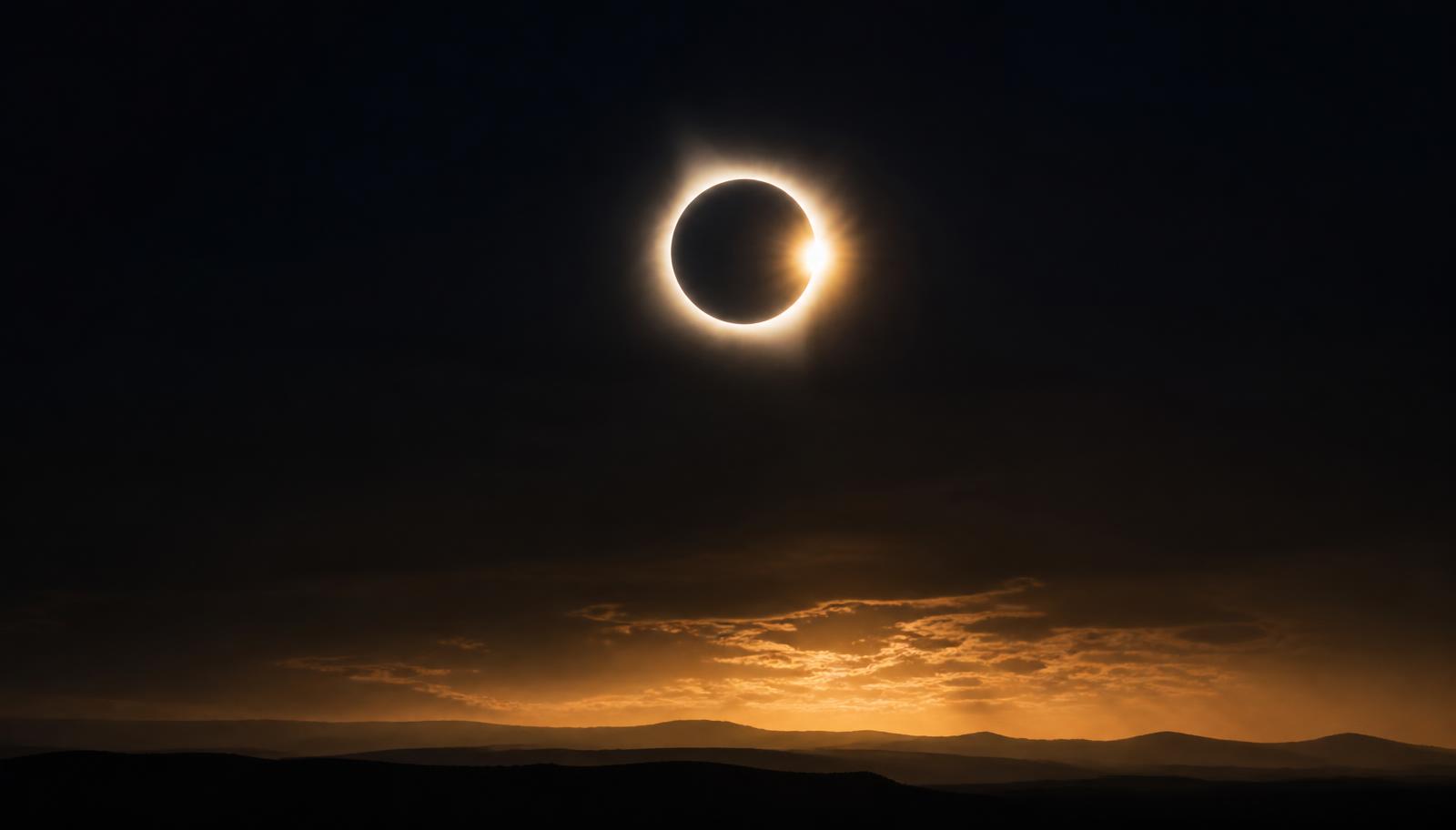
The August 12, 2026 Solar Eclipse — and Why Humanity Has Never Considered an Eclipse an Ordinary Event
For a few extraordinary minutes on August 12, daylight will begin to disappear.
The Moon will move between Earth and the Sun, casting its shadow across the Arctic, Greenland, Iceland and parts of the Iberian Peninsula.
In some places, the Sun will vanish completely.
The temperature may fall.
The light will change.
Animals may begin behaving as though evening has suddenly arrived.
And then, just as mysteriously, the light will return.
Today, we understand exactly what is happening.
We can calculate an eclipse centuries in advance. We can map the path of its shadow across Earth almost to the second.
But for most of human history, an eclipse was something profoundly different.
It was an interruption.
A moment when the natural order appeared to stop.
And perhaps that explains why cultures separated by oceans, centuries and belief systems repeatedly treated eclipses not simply as astronomical spectacles, but as thresholds.
Moments to become still.
Moments to observe what was changing.
And sometimes, moments when one was specifically told not to look at the sky at all.
Perhaps there is something worth understanding in that.
First: What Is Actually Happening?
A solar eclipse occurs when the Moon passes between Earth and the Sun.
During a total solar eclipse, the apparent size of the Moon is just large enough to cover the brilliant surface of the Sun, briefly revealing its outer atmosphere — the corona.
The eclipse of August 12, 2026 is particularly remarkable.
AUGUST 12, 2026
Total Solar Eclipse
☉ Solar Eclipse in Leo — approximately 20°
Path of totality: Arctic · Greenland · Iceland · northern Russia · Atlantic · Spain · a very small area of northwestern Portugal
Partial eclipse visible across much of Europe.
Its path of totality travels across the Arctic Ocean, Greenland, Iceland, northern Russia, the Atlantic and the Iberian Peninsula, including northern Spain and, as NASA describes it, the very northwestern tip of Portugal.
Across much of the rest of Europe, the eclipse will be partial.
Portugal as a whole does not experience totality. In Lisbon, for example, the eclipse is partial, with roughly 95% of the Sun covered.
For observers in Spain and Portugal, it occurs unusually close to sunset, placing the eclipsed Sun low on the western horizon.
Did you know?
The eclipse begins around midnight in the Arctic, made possible by the midnight Sun — the Sun remains above the horizon even at that hour.
And there is an even stranger detail.
According to the European Space Agency, the eclipse path initially moves west-to-east — an unusual direction that ESA describes as moving 'back in time' — before shifting into the more familiar east-to-west direction.
Even astronomically, this eclipse has something unusual about it.
When the Sun Disappeared in the Ancient World
Imagine witnessing an eclipse thousands of years ago.
There is no astronomy app.
No countdown.
No scientific explanation.
It is daytime.
And suddenly the Sun begins disappearing.
Birds become quiet.
The air cools.
Shadows become unfamiliar.
The world darkens.
For an ancient observer, this was not simply something happening in the sky.
Something appeared to be happening to the order of existence itself.
Unsurprisingly, eclipses became some of humanity's most symbolically charged celestial events.
In ancient Mesopotamia, eclipses could be interpreted as omens connected with kings and kingdoms.
Ancient eclipse records eventually became extraordinarily sophisticated, however. Babylonian astronomers recognised repeating eclipse patterns, knowledge later connected with what became known as the Saros cycle — roughly 18 years between similar eclipses.
In ancient India, one of the earliest written descriptions of a solar eclipse appears in the Rig Veda, where the demon Svarbhānu obscures the Sun before its light is restored.
Across different Aboriginal Australian traditions, eclipses could be associated with disruption, danger or powerful supernatural events — although some traditions also demonstrate surprisingly sophisticated astronomical understanding.
And in Diné/Navajo tradition, an eclipse has traditionally been treated not as a spectacle to watch but as a sacred period of stillness, reverence and reflection.
The disappearance of the Sun represents a moment of death and regeneration.
Rather than gathering outside to watch it, traditional practice encourages withdrawal from ordinary activity.
The symbolism is striking.
While modern culture says:
Look. Photograph it. Capture it.
Some ancient traditions said:
Do not look. Become still.
Why Would Anyone Choose Not to Watch an Eclipse?
There are two completely different answers to this question.
The first is physical.
Looking directly at the Sun during the partial phases of a solar eclipse can permanently damage the retina. Proper certified eclipse glasses or indirect viewing methods are necessary.
Only during the brief period of complete totality — and only for observers within the path of totality — can the eclipse be viewed directly without solar eye protection. Eye protection is required again as soon as any part of the bright Sun reappears.
But there is another reason — one that belongs not to ophthalmology, but to symbolism.
For many traditional cultures, extraordinary celestial events were not entertainment.
They were encounters with forces larger than the individual.
The instinct was therefore not necessarily to consume the experience visually, but to respond inwardly.
And psychologically, this is fascinating.
Because an eclipse is quite literally an interruption of consciousness's oldest symbol:
light.
The Psychology of an Eclipse
Across cultures, light has repeatedly become a metaphor for consciousness.
We say:
I see.
It became clear.
I was enlightened.
I finally understood.
Darkness, conversely, became associated with what cannot yet be seen.
In Jungian psychology, this distinction becomes particularly interesting.
Carl Jung understood psychological development not as the elimination of darkness but as an encounter with what consciousness has excluded.
The unconscious is not simply something negative.
It contains what the conscious personality does not yet recognise.
Potential.
Fear.
Instinct.
Contradiction.
Desire.
The unlived parts of ourselves.
An eclipse therefore offers an extraordinary natural metaphor.
The Sun has not disappeared. It has merely become temporarily invisible.
And perhaps the same can sometimes be said of our own lives.
There are periods when direction disappears.
When certainty becomes unavailable.
When something that previously illuminated our path no longer seems capable of doing so.
Our instinct is often to panic and immediately create another answer.
But darkness does not necessarily mean that the light is gone.
Sometimes it means that something else needs to become visible.
The Astrology of August 12, 2026
Astrologically, this is a Solar Eclipse in Leo, around 20°.
And that matters.
Leo is associated with the Sun itself.
Identity.
Creativity.
Visibility.
Leadership.
Recognition.
The courage to express what is uniquely ours.
But this eclipse belongs to the Leo–Aquarius nodal axis, falling on the South Node side of that axis: the South Node is in Leo, opposite the North Node in Aquarius.
That changes the conversation.
The Leo–Aquarius axis asks one of the oldest questions of human development:
How do I become fully myself without losing my relationship with the collective?
Leo says:
This is who I am.
Aquarius asks:
And what does that individuality contribute to something larger?
LEO — Identity · Creativity · Visibility · Leadership · Self-expression
AQUARIUS — Community · Interdependence · Future · Networks · Humanity
The South Node does not necessarily tell us to reject Leo.
It asks us to examine its shadow.
Where has self-expression become performance?
Where has recognition become validation?
Where has leadership become identity?
Where are we trying to be seen instead of trying to be true?
And opposite this lies Aquarius:
community,
interdependence,
future,
networks,
ideas,
humanity.
This does not mean becoming less individual.
Perhaps it means becoming individual enough that belonging no longer requires performance.
An Eclipse Is Not a Manifestation Portal
Modern spiritual culture frequently describes eclipses as moments for setting intentions, manifesting desires or accelerating change.
Historically, astrology has often treated them rather differently.
Eclipses were considered powerful precisely because they represented periods when ordinary visibility was interrupted.
The symbolism was not:
Force something into existence.
It was closer to:
Pay attention to what is being revealed by what disappears.
That distinction feels important.
Perhaps an eclipse does not ask:
What do I want to create?
Perhaps it asks first:
What am I ready to stop carrying?
And Nature Notices Too
One of the most fascinating things about eclipses is that humans are not the only creatures that respond to them.
During the 2017 total solar eclipse in the United States, researchers studying wildlife through weather radar observed an overall reduction in normal daytime activity among birds and insects as conditions suddenly resembled sunset.
Another study, observing 17 vertebrate taxa at Riverbanks Zoo in South Carolina, found that 13 of the 17 — approximately 76% — behaved differently from their baseline during the eclipse.
Many began their normal evening routines.
Some species displayed behaviours interpreted as anxiety.
Certain birds gathered together.
Some animals moved towards shelters or sleeping areas.
Reptiles showed unusual changes in activity.
Nature responds remarkably quickly to changing light.
The reason is not mystical.
Light is one of the most fundamental biological signals on Earth.
Circadian rhythms, feeding, migration, sleep, reproduction and orientation are all influenced by environmental light.
When daylight suddenly becomes twilight in the middle of the day, millions of biological clocks receive an unexpected message:
night is coming.
And then, minutes later, morning appears to return.
What About Earthquakes?
The proximity of powerful earthquakes to eclipses has fascinated humans for centuries.
And the devastating magnitude 7.4 earthquake that struck western Colombia on August 10, only two days before this eclipse, understandably makes the coincidence feel particularly striking.
But coincidence deserves curiosity — not premature conclusions.
Earthquakes are caused by tectonic processes.
The gravitational relationship between the Sun, Moon and Earth does create tides not only in the oceans but very slightly within the solid Earth itself.
Some scientific studies have investigated whether tidal stresses may marginally influence the timing of certain earthquakes on faults already extremely close to rupture.
But a solar eclipse does not create a unique gravitational force capable of causing an earthquake.
From a scientific perspective, an eclipse is simply a particular alignment occurring at New Moon.
There is currently no evidence that solar eclipses themselves cause earthquakes.
And yet the association tells us something fascinating about human psychology.
When extraordinary events occur close together, the mind instinctively searches for a pattern.
Our ancestors did exactly the same thing.
Perhaps the interesting question is not whether the eclipse caused the earthquake.
Perhaps it is why human beings have always looked upward when the Earth beneath them suddenly changes.
Something Most People Do Not Know
There is another extraordinary fact about eclipses.
They will not exist forever.
The Moon is slowly moving away from Earth.
Very slowly — on average, about four centimetres each year.
But eventually, as the Moon continues to recede, it will appear too small in our sky to completely cover the Sun. NASA estimates that Earth will experience its final total solar eclipse roughly 600 million years from now.
Total solar eclipses will disappear from Earth.
Which means that we happen to exist during a remarkable period in planetary history when the apparent sizes of the Sun and Moon can align almost perfectly.
For a few minutes, one can cover the other.
Perhaps that is part of what makes an eclipse so extraordinary.
It reminds us that even the sky we assume is permanent is changing.
So Should We Watch the Eclipse?
Science says:
If you choose to observe it, do so safely, using proper solar protection during every partial phase.
Tradition offers another possibility.
You do not have to watch everything extraordinary that happens.
Some experiences can be met through stillness rather than observation.
Perhaps tomorrow's eclipse can become an experiment.
For a few minutes, put the phone away.
Do not photograph it.
Do not immediately interpret it.
Do not ask what it is going to bring you.
Notice instead what happens around you.
The quality of the light.
The temperature.
The birds.
The silence.
Your own body.
And perhaps, for a moment, close your eyes.
Not because the eclipse is something to fear.
But because sometimes we understand light differently after experiencing darkness.
A Jungian Reflection
Individuation does not ask us to become brighter and brighter.
It asks us to become more whole.
And wholeness includes what we can see and what remains hidden.
Perhaps this is why the eclipse remains such a powerful symbol after thousands of years.
The Sun disappears. But it has not gone anywhere.
The darkness passes.
The light returns.
And the world is apparently the same.
But the observer may not be.
Reflection
If something in your life were temporarily hidden from view, could you resist the urge to immediately replace it with certainty?
Perhaps the eclipse is not asking us to look upward.
Perhaps it is asking us to look within.
The Inara Beacon
Your sky. Your story.
Astrological events are collective.
How they meet your life is personal.
Explore how the current sky interacts with your own birth chart inside The Inara Beacon.
Sources & Further Reading
- NASA — Total Solar Eclipse of August 12, 2026
- NASA Science — Eclipses and the Moon
- European Space Agency — Solar eclipses
- U.S. Geological Survey — Can the position of the Moon or the planets affect seismicity?
- The British Museum — Babylonian astronomy and astronomical diaries
- Journal of Astronomical History and Heritage — Solar eclipses in Australian Aboriginal traditions (Hamacher & Norris)
- Servicio Geológico Colombiano — Official seismic information (San José del Palmar, Chocó, 10 August 2026)
- Scientific Reports (Nature) — Continental-scale behavioral response of birds to a total solar eclipse (2025)
- Animals (MDPI) — Total Eclipse of the Zoo: Animal Behavior during a Total Solar Eclipse
- NASA — The Moon Is Front and Center During a Total Solar Eclipse
- Reuters — Colombia rescue efforts press on after quake, death toll expected to rise
Your sanctuary
This reading speaks to the sky in general. Your sky is unique, woven from the day you arrived. Step inside and let it speak to you.
Read my own sky